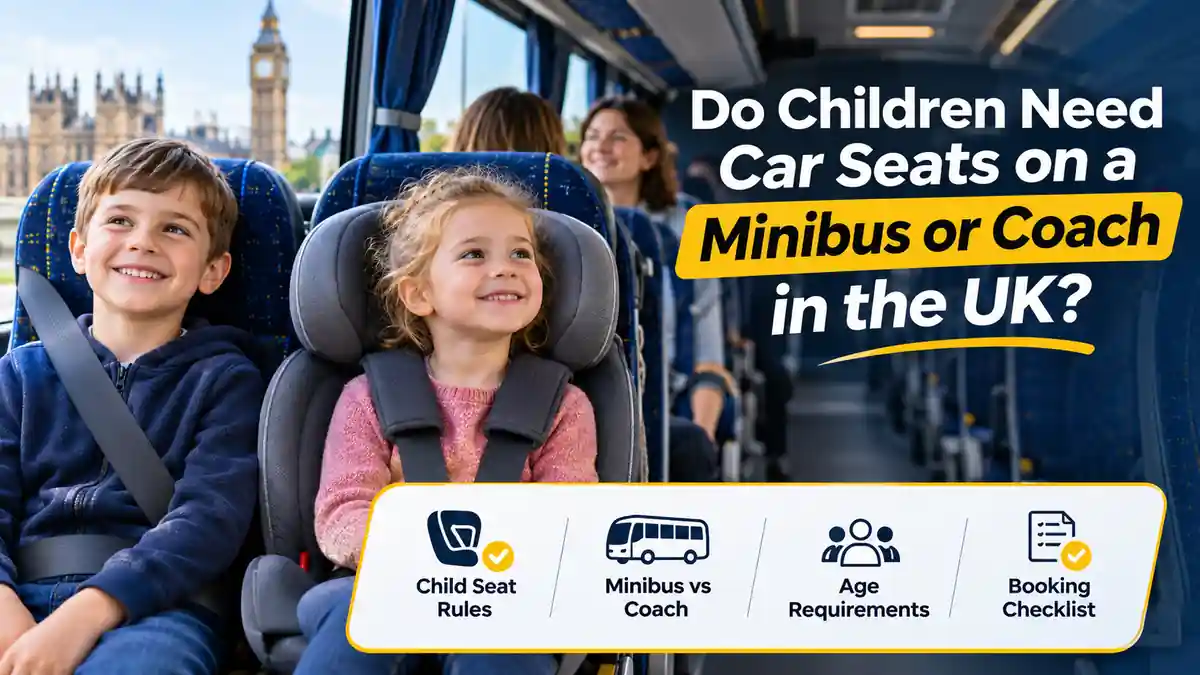
Do Children Need Car Seats on a Minibus or Coach in the UK?
You have booked a family outing, a school visit or a journey to the airport. The adults are sorted, the luggage is packed, and then somebody asks a perfectly reasonable question: does the youngest passenger need a car seat? The answer depends on whether you are travelling in a minibus or a coach, the child's age, and the restraints fitted to the vehicle.
It is worth checking before the day of travel. A coach is not simply a very large car, and the rules familiar to parents driving their own vehicles do not translate directly to group transport. This guide explains the practical differences and the questions to ask when arranging minibus or coach hire with a driver in the UK.
Do children need a car seat on a minibus or coach?
Not every child on a minibus or coach is legally required to travel in a child car seat. UK rules provide specific arrangements for these vehicles. According to GOV.UK's guidance on when children can travel without a car seat, minibus and coach companies are not obliged to supply child car seats. If you want to use one, you should normally arrange your own and check whether it can be fitted safely.
The distinction between a minibus and a coach matters. GOV.UK states that on a coach, children may travel without a child car seat or seat belt if these are not available. In a minibus, children aged three or over must use an available suitable child car seat; otherwise they must use an adult seat belt where one is fitted. Where neither is fitted, children must use rear seats. The rules also vary with age and seating position, so avoid assuming that a policy for one vehicle applies to another.
What about babies and children under three?
For babies and toddlers, comfort and safe positioning deserve particular attention. Minibus rules differ from those for a family car. Government guidance and the Department for Transport's seat belts and child restraints booklet explain the specific exceptions and seating requirements. Under-three children in minibuses should travel in an appropriate child restraint if one is available, or in a rear seat where the relevant exception applies.
Legally permitted does not always mean the most suitable choice for a particular child. If you are travelling with a baby, ask the operator about the actual vehicle, whether a suitable infant carrier can be fitted and what type of belt or anchorage is available. Do this before paying a deposit rather than arriving with a seat that cannot be secured correctly.
Can you bring your own child seat on a hired minibus?
Often the most practical approach is to discuss bringing your own seat, but compatibility must be confirmed. Not all child seats work with every type of passenger belt. A seat that requires ISOFIX fittings cannot be assumed to fit in a coach or minibus, and a lap-only belt may be unsuitable for a restraint designed for a three-point belt.
When you contact the operator, give the child's age, approximate height and weight, and the make or installation requirements of the restraint. Ask whether the proposed seating position has the right belt and whether the seat can be fitted in accordance with its manufacturer's instructions. GOV.UK's child car-seat guide explains approved seats and safe installation requirements.
Do not plan to hold a baby on an adult's lap as a substitute for a properly considered travel arrangement. If the vehicle and restraint combination is unsuitable, discuss a different vehicle or travel option before confirming the journey.
What are the rules for school trips and organised groups?
School trips need a little more preparation than a family day out, particularly when children of several ages are travelling together. Specific requirements apply to seat belts on organised journeys involving children. For example, the Department for Transport's vehicle seat-belt guidance addresses forward-facing seats and minimum belt provisions on certain organised children's trips.
Teachers and organisers should therefore confirm not just how many passengers a vehicle seats, but which seats and restraints will be available for the actual age group. They should also consider how pupils will be supervised during boarding, at stops and on the return journey. A seating plan can make those responsibilities easier to manage.
For wider preparation, see All-Ways Travel's school-trip planning and transport articles, which cover the wider journey rather than the specific issue of child restraints.
Do older children need to wear seat belts?
Passengers aged 14 and over must wear a seat belt where fitted in minibuses, buses and coaches, subject to limited exemptions. The Highway Code, rule 99, sets out this responsibility. Younger children's requirements are more nuanced and depend on the vehicle and circumstances.
For organisers, a sensible routine is to explain the belt arrangements before setting off, check that nobody is sitting in a luggage space or blocking the aisle, and make time for proper boarding. Seat-belt rules should not be treated as an afterthought simply because the journey is relatively short.
Five things to confirm before booking transport with children
- Exact passenger ages: include babies, toddlers and children, not just the total headcount.
- Vehicle type: confirm whether the booking will use a minibus or coach, as the rules and fittings can differ.
- Seat-belt configuration: ask which seats have belts and whether those belts are compatible with any child restraints you plan to bring.
- Pushchairs and bags: declare bulky items so they can be stowed away from exits and aisles.
- Written agreement: record any special seating requirements with the operator before travel.
For family airport transfers, allow time for fitting and removing a restraint as well as collecting luggage. For schools, share the information with the trip organiser and any supervising adults.
How to arrange family or school transport with All-Ways Travel
All-Ways Travel provides driver-included minibuses and coaches for group journeys around the UK. To discuss a vehicle for a party that includes young children, provide the route, dates, passenger ages, and any seat or equipment requirements through the contact page. Ask the team to confirm the suitability of the vehicle offered; a child's car-seat compatibility should never be assumed from the advertised seating capacity alone.
Frequently asked questions
Do coach hire companies have to supply child car seats?
No. GOV.UK says minibus and coach drivers and companies are not required to provide child car seats. If you want one, arrange it in advance and confirm safe installation with the operator.
Can a two-year-old travel on a coach without a car seat?
UK rules have specific exemptions for coaches, but that does not establish that every travel arrangement is suitable for an individual toddler. Ask about the vehicle and safe restraint options before booking.
Can I use an ISOFIX child seat in a hired minibus?
Only if the actual vehicle has compatible fittings and the child seat is approved for that installation. Do not assume ISOFIX is provided.
Do children need seat belts on school coaches?
Requirements depend on the type and age of vehicle and the organised trip. Ask the operator about the actual seat-belt provision and check the official guidance for your journey.
The bottom line
The right question is not simply “does a child need a car seat?” It is “what restraint and seating arrangement is appropriate for this child on this vehicle?” Confirm that before you travel and your group can concentrate on enjoying the journey rather than solving a seat-belt problem at the kerb.
